
Professor Ian Walker relies on a century of coastal history to predict the future of California’s environment. To study vegetation loss on the Oceano Dunes in San Luis Obispo County and model subsequent dust pollution, the UC Santa Barbara geographer depends on an extraordinary historical record: a collection of 9-by-9-inch aerial photographs on film dating back to the 1920s, held by UCSB Library’s Department of Special Research Collections (SRC).
However, Walker — and other researchers using the collection — faced a race against time. Roughly 20 percent of this irreplaceable collection is threatened by vinegar syndrome, a chemical deterioration that causes film to shrink, become brittle, emit a strong odor, and eventually become unusable. The Library stored vulnerable film in specialized refrigerators, but these costly units could only hold a fraction of the at-risk materials, leaving critical environmental data in jeopardy. Walker also required high-quality scans for his research, but outsourcing was cost-prohibitive, the Library’s existing digitization labs lacked the ventilation and specialized equipment to digitize deteriorating film safely, and the uncommon film format limited ready-made commercial digitization system options.
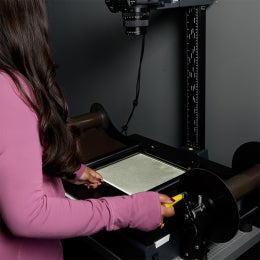
Turning a preservation crisis into innovation, the Library collaborated across campus to build a custom, in-house digitization lab for aerial photos. Staff from the Library’s Digital Library Development Department and SRC partnered with the UCSB Physics Machine Shop and UCSB Environmental Health & Safety to retrofit a workspace with specialized ventilation, create a camera-based system that digitizes materials up to 2,000 percent faster than previous equipment, and design safe, efficient workflows that enabled trained Library student assistants to digitize all the refrigerated film at a fraction of the projected outsourcing cost.
The results transformed Walker’s research. "Air photos are critical for identifying trends and patterns of vegetation decline," he said. "The Library's high-resolution scans give us the exact blueprint we need to restore native dunes and improve public health outcomes on the Central Coast."
The Library is now working to digitize the remaining at-risk film. By turning a preservation challenge into a modern solution, UCSB Library ensures future generations can continue protecting California’s changing landscapes.